The Tirpitz
Chronicles
A Parody of the
Prussian Patriarch - Tirpitz von Koenig
An Autocrat of the
Old Order

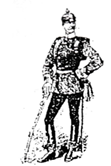 He makes mistakes,
but inevitably escapes any personal culpability. Like the Iron
Chancellor he arranges things to lay blame on the enemies as
aggressors instead of on the peace-loving nation of Prussia.
Like Frederick the Great he is beset round about by
antagonists who compel him to take assertive aggressive action
purely as a preventative to stave off his own and his people's
destruction.
He makes mistakes,
but inevitably escapes any personal culpability. Like the Iron
Chancellor he arranges things to lay blame on the enemies as
aggressors instead of on the peace-loving nation of Prussia.
Like Frederick the Great he is beset round about by
antagonists who compel him to take assertive aggressive action
purely as a preventative to stave off his own and his people's
destruction.
(It should be noted
that this publication may be taken as the preeminent Prussian
answer to the brazen bombast and the bilious bogus of the
yellow-eyed Bavarian, Baron von Muenchhausen,
the nemesis of von Koenig).
This edition is
translated and edited from the Personal Diary and Ship's Log
of Captain von Koenig by Hugo Kistenmacher
(nom de plume).
WARNING - This may
be hazardous to your feelings.
Unabashedly the
“Tirpitz Chronicles” stand for the old prides and prejudices
of a land of northeastern/north central Europe which has
dissolved from the scene. If you are an ethnic from any of
Prussia’s age old enemies or/and are easily offended, stop
right here. If you are an ethnic Prussian or descended from
such or are inclined to look favorably on such, well then,
read on.
The old medieval court jester though eccentric in mannerism and dress, yet often propounded truth and wisdom by means of his humor. In our jesting we hope there is a grain of wisdom and kernels of truth that will be discovered between the words. At times with more tongue in cheek and at times with more warmth in heart Cousin Hugo relates and we read of the exploits of a naval captain who hailed from a country whose standing army was its pride and glory.
\\hat does the word
'Prussian' mean to you? Arrogance, harsh discipline, cruel militarism
or unswerving loyalty, devotion to duty and to an ancient
regime, system, efficiency and discipline that produce
results? Prussia
could never have been as wicked as its detractors assert,
though its detractors have the preponderance of numbers on
their side in historical/political writings. If we Koenigs err, we err in the opposite
extreme and blatantly so in defending and propounding against
swelled ranks of detractors. For what
purpose? Humor alone?
Perhaps Prussia was
never as it was thought to be by either friend or foe. ln any event, who today says, ‘My
ancestors came from Prussia?' There
are some, though for the most part those uninitiated into the
truth would prefer to say they are of German descent instead
of... Even today so many
years after the end of World War 2 who is pictured as a hero,
who is German. Even today we are
still fighting the vicious Krauts in WW2 movies being
produced. And while we are at it, Americans supposedly like to
help an underdog, right? When the modern Prussian nation was
taking shape under Frederick the Great, you could not have
found more of an underdog than Prussia with its king, Old Fritz.
it is also lost sight
of that Napoleon was a tyrant who subjugated the Germans and
humiliated the Prussians. It was finally Wellington's English
army and Bluecher's Prussian army
which defeated Bony. True, Bluecher
was
semi insane, though that should do little to detract from his
loyalty to Wellington and prowess on the field of battle.
Austria is viewed as
the epitome of gemuetlichkeit. To
be Viennese was to be gracious and cosmopolitan. But this same
Austria sought time and again to suppress the yearnings of
Prussia for a part on the world stage. The hereditary home of
the Hapsburgs sought to greedily maintain her hegemony among
the German-speaking peoples whether deserved or not.
It took a firm hand
to unite Germany. Bismarck is viewed as a master of real politik and a deceiver. Was he really
so much worse than his contemporaries, or merely more
successful?
In WWI Germany was
but one of numerous nations poised for inevitable armed
conflict. Prior to WW2 many true Prussians disdained the
monster Hitler. When war did come Prussians like Heinz Guderian were confronted with a
heart-rending dilemma as they loved their country and yet did
not continence the Nazi.
There is an old saw
that goes, 'many nations possessed armies, while Prussia was
an army that possessed a nation’. There will be wars and
rumors of wars untll the end of
time. To be prepared for such is wise. To not shilly-shally around once war begins.
but to seek to win as soon as
possible is best for one's own people. How many needless
casualties haven't there been due to unpreparedness? Preemptive and
prepared Prussia was, but as Cousin Hermione has written,
alas. “. . . Prussia’s long gone,
now, but a state of the mind. . .”
The "Tirpitz
Chronicles" have been authorized by the Koenig family. We thank our grand rnatriarch Aunt Minnie for
proof-reading the manuscript.
This is a compilation of Cousin Hugo's mailings to the
family to date. In
celebration of this publication we have also. In addition to
dedicating this work to Heiny
(Koenig) Pickelhaube, we have
also commissioned an oii painting
of that which bears Heiny’s name
by the artist Maurice de Hallman, a copy of which you see with
this publication.
Some time back a
relative of ours in the old Fatherland discovered an old sea
chest in his ancient house. Realizing the tremendous import of
his find, he saw to the smuggling of the ship’s iog and diary out of the then Red
regime of the German Democratic Republic (which was not
democratic, nor a republic and which rolled over and barked at
Russian spoken commands). Since there are so many of our
kindred in Germany and elsewhere, thanks in large measure to
Tirpitz' travels, the precious books were smuggled easily
through a family network to the West. It was decided since
Hugo is foremost of the literati of our expansive family, he
was asked to undertake the authorized translation and eventual
publication to the family. The desire was to finally answer
once and for all scurrilous charges leveled against our
progenitor. At the outset below we starkly repudiate the
infamously-false charge of piracy. Once Hugo got into the
translation work he found there was so much more to tell. With
appropriate Stolz he undertook
the noble task of fighting for truth, justice and the Prussian
way in disclosing to the unlistening
world the facts about that man in the seven league boots: Captain Tirpitz von
Koenig.
Author Panel Review for The Tirpitz Chronicles
As a team dedicated to exploring literature that challenges
conventions and captivates readers, we were truly enthralled by
Tirpitz by David Koenig. This book is a masterful blend of
satire, historical commentary, and irreverent wit that
reimagines the Prussian legacy with an unparalleled depth of
humor and insight. It is more than a historical parody; it is an
ingenious critique of power, legacy, and the narratives that
shape our perception of history.
Koenig's ability to weave satire with historical undertones is remarkable. From the very first page, the book immerses readers in the life and misadventures of Tirpitz von Koenig, a character whose exploits blur the line between historical accuracy and grandiose embellishment. As a parody of the Prussian patriarch archetype, Tirpitz delights in dismantling and reconstructing myths of grandeur, military prowess, and political machinations with sharp wit and biting irony.
What sets this book apart is its ability to challenge perspectives while remaining endlessly entertaining. Koenig has crafted a narrative that reads like a forgotten historical document, unearthed and reinterpreted through a modern satirical lens. With eloquent prose, playful exaggeration, and a keen understanding of the political and social structures of the past, he offers readers an experience that is both intellectually engaging and laugh-out-loud funny.
Beyond its humor, Tirpitz serves as a thought-provoking examination of leadership, nationalism, and the absurdity that often accompanies both. Koenig's writing prompts readers to question how history is recorded and remembered, while enjoying a wildly entertaining journey through the past.
We believe Tirpitz has immense potential to resonate with a wide and diverse audience. With the right marketing approach, this book could easily become a favorite among history buffs, satire enthusiasts, and readers who appreciate a clever and unconventional approach to storytelling. Koenig's unique voice and ability to balance humor with insightful critique make this a standout work, one that deserves recognition and discussion.
This book is poised to provoke, entertain, and enlighten. With its universal themes, brilliant wit, and razor-sharp commentary, Tirpitz stands as a testament to the power of satire and the enduring relevance of history in modern discourse.